|
|
- History
- Physical examination
- Laboratory findings (Meares-Stamey procedure)
- Transrectal Ultrasonography (TRUS)
- Urethrocystoscopy
- Other investigations
In my patients, I try to analyze the following three cardinal symptoms
in detail:
- PAIN/DISCOMFORT
Duration. Ontset. Intensity. Location (very important to note: assymmetry?
- constantly unilateral pain is frequent and usually associated with
pathology of the SV of the same side!). Variable or constant? Painfree
intervals?
- MICTURITION
Recurrent urinary infections with evidence of bacteria? (--> CBP)
Irritative symptoms: Frequency? Urgency? (--> bladder neck irritation).
Burning sensation at micturition? (--> urethral irritation; inflammatory
changes at the level of the veru is often projected to the distal urethra)
Obstructive symptoms: Hesitancy? Reduced flow? Dribble? Haematuria (terminal?)
- EJACULATION
Frequency of ejaculations (often spontaneously reduced due to discomfort
and reduced libido)? Burning discomfort at ejaculation? Spasm-like discomfort
after ejaculation (on which side)? Reduced ejaculatory pressure (spermatic
fluid pouring out slowly)? Reduced volume? Appearance (yellowish, brownish-blood
stained = haematospermia, clumpsy, watery thin)?
- Exclusion of inguinal hernia and inflammatory changes at the insertion
of the adductor muscles in the pubic bone.
- Scrotal content: in prostatitis patients often normal palpatory
findings, except: a) slight swelling of the epididymis in obstruction,
b) diffuse or focalized induration of the epididymis as remnant of prior
inflammatory involvment, c) sensitivity on palpation of the epididymis
- Digital rectal examination (DRE): The prostate presents frequently
varying consistency with softer (edematous) areas (often sensitive to
pressure) and harder nodes (calcified areas, prostatic cancer has to
be excluded). At digital pressure, the maximum pain can often be elicited
in the mid-line near the basis of the prostate, at the site where the
ejaculatory ducts pass though the gland and, especially, at their point
of entry into the prostate ("confluens") and at the veru. Sometimes,
the lower part of the SV can be reached with the finger; normally, they
should not be palpable; however, in patients with "prostatitis", they
are sometimes clearly detectable, engorged or indurated, and in some
cases hypersensitive.
Not rarely, palpation reveals severe tenderness of the pudendal nerve
at the point where it slips under the sacrospinal ligament/muscle through
the lesser ischiadic foramen and enters the channel of Alcock. To avoid
false positive responses, extreme care (slight touching is sufficient)
has to be used. The nature of this paenomenon, which, for practical
purposes, I use to call pudendal syndrome, remains
obscure. It may represent a form of entrapment neuropathy, similar to
e. g. the carpal tunnel syndrome, with the nerve bent and/or compressed
under the edge of the ligament in the narrow slot it has to pass to
reach the lesser pelvis. It remains to be investigated if this compression
is a consequence of continuous reflectory musle contraction of the pelvic
floor (due to irritation in the periphery, like prostatitis) or if it
may be caused by repeated direct mechanical irritation against the bony
prominence of the ischiadic spine (bycicle riding or prolonged sitting
in vibrating environment, like truck-driving etc). It may also have
a connection to the findings of R. Anderson et al (Stanford) regarding
their pelvic-floor-hypertension-theory. I have thought about, but never
been forced to surgical exploration of the area, since the few patients
with severe pain I so far attributed to this cause, have improved after
massage of the sacrospinal ligament (firm pressure on the ligament in
an attempt to relax and elongate the muscular components). A similar
syndrome in the immediate neighborhood, known as the piriformis
syndrome, affecting the ischiadic nerve, is treated successfully
by stretching exersizes on the piriform muscle. In refractory cases,
transection of the ligament's attachment to the ischiadic spine would
be a conceivable way to release the nerve (should be foregone by neurotransmission
speed measurement). Another treatment option may be infiltration by
cortisone.
The Drach-classification is based on this test. In order to perform it
correctly, the prostatic exprimate has to be recovered according to the
procedure standardized by Meares and Stamey in 1968: before prostatic massage, 2 urinary samples are taken (from the
first 10 ml and from the mid-stream urine); after prostatic massage, the
experessed prostatic secretion and the first 10 ml urine passed after
massage are collected. These 4 batches are analyzed for the presence of
bacteria and white blood cells. A finding of bacteria and/or inflammatory
cells is considered specific for the prostate if the concentration of
these components is significantly higher in the samples taken after prostatic
massage then in the midstream urine. Unfortunately, this procedure is
complicated and time-consuming, and therefore, most urologists are reluctant
to perform it routinely. Furthermore, the classification does not change
very much in terms of treatment policy: most urologists will try, further
or later, a course of antibiotics and antiphlogistics, regardless of the
entity of "chronic prostatitis", though puritans among us urologists do
not recommend such a trial-and-error policy. On the other hand, in lack
of better scientifically accepted treatment resources, few of us can resist
the attempt to try such treatment which at least improves the condition
in a part of our patients, instead of reiterating the tale of something
"to learn to live with". The Meares-Stamey procedure is therefore mostly
relegated to clinics who do research on prostatitis, whereas most urologists
do not perform it routinely. It is without doubt valuable, because it
legitimates a long-term antibiotic therapy in chronic bacterial, and helps
to avoid such a potentially risky therapeutical approach in the vast majority
of patients, those with nonbacterial prostatitis and prostatodynia, but
it offers no concrete guide-lines for how to treat these latter conditions.
The author uses a simplified approach, generally starting with cell-count
and culture from urine before and from expressed prostatic secretion (EPS)
after massage, only. A negative urinary culture combined with positive
culture from the EPS is sufficient evidence for CBP, negative EPS and
negative culture excludes the diagnosis CBP. If the results are ambiguous,
the complete standard procedure has to follow.
in 1968: before prostatic massage, 2 urinary samples are taken (from the
first 10 ml and from the mid-stream urine); after prostatic massage, the
experessed prostatic secretion and the first 10 ml urine passed after
massage are collected. These 4 batches are analyzed for the presence of
bacteria and white blood cells. A finding of bacteria and/or inflammatory
cells is considered specific for the prostate if the concentration of
these components is significantly higher in the samples taken after prostatic
massage then in the midstream urine. Unfortunately, this procedure is
complicated and time-consuming, and therefore, most urologists are reluctant
to perform it routinely. Furthermore, the classification does not change
very much in terms of treatment policy: most urologists will try, further
or later, a course of antibiotics and antiphlogistics, regardless of the
entity of "chronic prostatitis", though puritans among us urologists do
not recommend such a trial-and-error policy. On the other hand, in lack
of better scientifically accepted treatment resources, few of us can resist
the attempt to try such treatment which at least improves the condition
in a part of our patients, instead of reiterating the tale of something
"to learn to live with". The Meares-Stamey procedure is therefore mostly
relegated to clinics who do research on prostatitis, whereas most urologists
do not perform it routinely. It is without doubt valuable, because it
legitimates a long-term antibiotic therapy in chronic bacterial, and helps
to avoid such a potentially risky therapeutical approach in the vast majority
of patients, those with nonbacterial prostatitis and prostatodynia, but
it offers no concrete guide-lines for how to treat these latter conditions.
The author uses a simplified approach, generally starting with cell-count
and culture from urine before and from expressed prostatic secretion (EPS)
after massage, only. A negative urinary culture combined with positive
culture from the EPS is sufficient evidence for CBP, negative EPS and
negative culture excludes the diagnosis CBP. If the results are ambiguous,
the complete standard procedure has to follow.
TRUS has not gained wide-spread use in the assessment of "chronic prostatitis".
There have been some isolated reports on sonographic findings associated
with "CP", but others have discarded the technique as "not recommended
in the routine evaluation of men with prostatitis" (de la Rosette &
Debruyne: "Nonbacterial Prostatitis: A Comprehensive Review" in Urology
International 1991;46). In my experience, TRUS is by far the most useful
means of investigation in this category of patients. It delivers
1. an image of the prostate and the seminal vesicles
2. allows to identify the point of maximum pain/discomfort by exerting
careful pressure with the probe (in analogy with clinical experience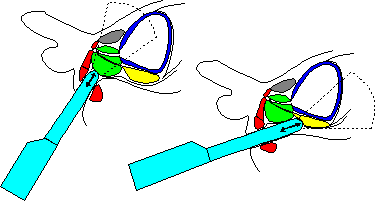 in other anatomical sites, e g the acute abdomen, I found this test extremely
helpful and in many cases diagnostic). It is, however, necessary that
the patients are examined during phases with active symptoms, i e the
discomfort has to be present; pressure on an obstructed organ is not necessarily
painful if the organ is relaxed even in presence of emptying impairment;
obstruction can also appear intermittently (kinking, compression form
outside etc); in long-standing obstruction, the patient has adapted to
the pressure increase and does not experience any discomfort. Therefore,
this pressure test is not always positive if the patient comes to the
examination in a symptomfree interval.
in other anatomical sites, e g the acute abdomen, I found this test extremely
helpful and in many cases diagnostic). It is, however, necessary that
the patients are examined during phases with active symptoms, i e the
discomfort has to be present; pressure on an obstructed organ is not necessarily
painful if the organ is relaxed even in presence of emptying impairment;
obstruction can also appear intermittently (kinking, compression form
outside etc); in long-standing obstruction, the patient has adapted to
the pressure increase and does not experience any discomfort. Therefore,
this pressure test is not always positive if the patient comes to the
examination in a symptomfree interval.
After examining several hundreds of patients with "prostatitis", using
a multifrequency transrectal ultrasound probe, the author has come to
the following conclusions regarding the necessary technical equipment:
- the probe has to be slim at the tip, not like several electronic
transvaginal transducers on the market with broad detection sectors
- the examination sector should be shiftable in different planes (transversal
and longitudinal), and has in any case to have the capability of axial
straightforward projection (in order to allow exact identification of
the part of the organ where the pressure is applied in axial direction)
- the best examination frequency is 6-6.5 Mhz, it works better than
7.5 Mhz, but a 7.5 Mhz transducer will be acceptable. 5 Mhz transducers
are totally useless and will not be able to provide 95% of the information
you can get with the 6 MHZ. I have tested this extensively with my Siemens
multifrequency multiplane probe.
What can be detected at TRUS?
Click to see Examples
of TRUS-findings
- Median prostatic cysts (utricular cysts,
Müllerian cysts):
Such cysts can be found in as many as 12.5% of all patients with "chronic
prostatitis". A dutch researching urologist, Dr. Pieter Dik of Utrecht,
Netherlands, has done a lot of clinical research on young men with "chronic
prostatitis", finding cysts in about the same frequency as in the author's
series. A report has recently been accepted by the journal of Urology
and will be published soon. What is important about detecting these
cysts are the results of therapy (a simple transurethral procedure can
cure the patient; see section on therapy).
- Calcifications:
These findings are much more frequent in patients with a history of
prostatitis then in men who never had any such episodes. However, one
has to take into consideration that prostatitis can occur silently,
either due to a low degree of inflammatory activity over a longer period
of time which does not cause much disturbance, or because of the inflammatory
process being located in an area where the density of sensory nervous
endings is low and, perhaps, where surrounding high sensitive areas
like the urethra or the intraprostatic seminal tract are not involved.
After systematic observation of these lesions (comparing symptomatic
and asymptomatic individuals), I would categorize them grossly as follows:
a) Isolated granules distal to the veru in the periphery of the urethra
are frequent and not very specific.
b) Nests of coars or spotty calcifications in either lobe are generally
indicative for a focal chronic inflammatory process which may be active
or not(burned-out). The presence of edema (a hypoechoic area surrounding
these granules) is likely to indicate activity, especially in presence
of symptoms. Strikingly often, such nests are located in the median
lobe (central zone) in close proximity to the bladder neck, proximal
urethra and the ejaculatory ducts (which maybe an explanation for the
combination of irritative bladder symptoms and symptoms/changes referable
to the seminal tract. It is necessary to point out that these findings
are only reliable if the patient has not yet developed significant benign
prostatic hyperplasia (BPH), as in the case of older patients; the sonographic
appearance of BPH is very inhomogeneous and does not allow detailed
evaluation of minor regions in the inner parts of the prostate.
c) Sometimes, tiny calcified granules are found inside the veru, not
rarely combined with dilation of the ejaculatory ducts and/or the seminal
vesicles. Such a finding can be diagnostic and almost always related
to intermittent obstructive symptoms of the seminal tract and dysuria
(burning at micturition).
- Edema of the verumontanum:
With good sonographic equipment readily recognizable as a much larger
then expected hypoechoic zone (urologists know from urethroscopy how
large an unaffected veru should be). Sometimes, a single or a few tiny
calcifications can be seen inside this area, more often the wall of
the veru appears as a dotted hyperechoic line, the pendent to the subepithelial
microcalcifications often found at cystoscopy in these patients. Edema
of the veru, if present and especially if combined with typical irritative
symptoms relatable to this meeting spot of urinary and seminal tract
(see section on symptoms), is a very important finding. The examinating
urologist should try to decide if this is the only area affected or
if there are inflammatory changes in the neighborhood (prostatic lobes)
which can be the cause or the consequence of changes in the veru. In
either case, an operative procedure (transurethral ablation of the veru
and, in cases of foci in the prostatic lobes, ultrasound-guides trasurethral
resection of affected areas) can resolve the problem in severe cases,
in whom pharmacologic therapy trials and prostatic massage has been
inefficient.
- Edema of the prostatic lobes (peripheral zone):
Can only be seen if the edema is sectorial as a consequence of obstruction
and/or inflammation of one or a few prostatic glands. The image is typical:
hypoechoic cone-shaped (on the section appearing as a sector with the
base towards the prostatic capsule and the point towards the veru) areas,
with clean demarcation against the surrounding homogeneous tissue of
the peripheral zone. As with other sonographic changes, congruence with
specific symptoms (in this case perineal pain) and hypersensitivity
to pressure (finger, ultrasound transducer) will strengthen the diagnosis.
These patients will consistently do well after some sessions with prostatic
massage combined with antiinflammatory drugs, aiming at reducing edema
and expressing the retained secretion. Only in cases of calcifications
located in the outlet portion of this sector, minimal transurethral
resection should be attempted in refractory cases.
- Dilated Ejaculatory Ducts:
Normal ejaculatory ducts are barely visible at ultrasound and merge
often totally with surrounding tissue. If they appear as a clearly visible
hypoechoic ribbon, they are either filled or their wall or surrounding
connective tissue sheeth is edematous (inflamed). Grossly distended
ejaculatory ducts indicate always outlet obstruction at the level of
the veru. Both ducts pass close to each-other through the prostate and
are not always discernable. If only one ejaculatory duct is affected,
it can usually be identified, and the distension can be followed up
to the level of the deferent duct above the base of the prostate. Many
times, also the seminal vesicle of the same side appears distended,
in other cases not (possible cause: post-inflammatory shrinkage of the
seminal vesicle). Surgery in such cases can be resolutory.
- Changes of the Seminal Vesicles:
The Seminal Vesicles are more frequently involved in prostatitis than
usually recognized, and pathology in these glands can often persist
for long time after the inflammatory process in the prostate has subsided.
My investigations have shown to me, that the Seminal Vesicles are far
more often the site of maximum sensitivity when touched with the transducer
than the prostate (only the area where the ampullae of the deferent
ducts, lying near each-other, pass beneath the bladder base before entering
the prostate, is even more often the site of maximum pain). I think
that the recognition of this fact is of utmost importance: in fact,
even if definitive eradication of the inflammatory process, wherever
it starts, seems difficult or unpredictable, the symptoms (=pain) could
be treated if therapy is directed towards the Seminal Vesicles in those
cases. The appearance of the Seminal Vesicles is often pathologic:
- dilation: general or segmental. Frequent finding: large,
dilated spaces like cysts, generally representing dilated acini.
- shrinkage: small collapsed glands with shortened length,
often with thickened wall, more or less painful, no variation in
size related to sexual activity/abstinence
- calcifications: appear as: a. calcification of the wall
lining; b. calcified detritus; c. stones - especially important
to recognize stones which might obstruct the outlet; d. perivesicular
calcifications
Another most important aspect is laterality: in a large group
of patients, symptoms are constantly unilateral (e g pain in either
groin or testicle). In most of these cases, the Seminal Vesicles show
pathological findings (tenderness and/or appearance) on the same side,
only. Finally, it is important to note, that patients with prostatodynia
with intermittent symptoms should be preferably investigated when the
pain is present. The reason for this is that the pain in those patients
often is functional: seminal vesicles in spastic contraction (due to
irritation from some offending mechanism in the neighborhood or, more
often, from functional or organic obstruction) are tender when touched,
but may be completely indolent after relaxation. An investigation in
an asymptomatic patient is, however, not useless because the painful
reaction of the seminal vesicles is sometimes started by the manipulation
during the examination. In other case it should be repeated when the
symptoms are present. The seminal vesicles, being a hollow muscular
organ, could be resembled to the bowel: if the bowel is cramping, it
is tender and the pain can easily be related to the offending bowel
segment; if it relaxes, it becomes indolent or only slightly tender,
rendering the diagnosis much difficult or impossible.
- Surrounding organs:
In case of diffuse pain not referable to the organs listed above, I
always try to identify the site where I can generate the maximum pain
reaction similar or identical to the pain the patient seeks me for.
If no pain similar to the patient's discomfort can be triggered, a thorough
DRE of the area around the lesser ischiadic foramen to check for hypersensitivity
of the pudendal nerve will often reveal a positive finding, in my view,
of great importance (see DRE). Exploring this area with the probe is
awkward and not sensitive enough. Other sites external to the urinary
or seminal tract causing "prostatitis-like" symptoms seem very rare
(e g inflammatory processes in the ischiorectal fossa or in the paravesical
space.
In summary, transrectal ultrasonography is, so far, the best investigation
at hand to get closer to a diagnosis in "chronic prostatitis". It can
provide guidelines to therapy, especially regarding those cases potentially
suitable for surgery. It needs, however, significant experience to interpret
the different findings and correlate them to the clinical picture and
other examinations. "Chronic prostatitis" is a very inhomogeneous disorder
with innumerate subentities, difficult to categorize, difficult to investigate.
Transrectal ultrasound is not the answer to all questions, far from
that, but it delivers a lot of information if properly performed. On
the other hand, there is no better method available, today, to dig into
this area with very complicated micro-anatomical structure and complex
physiological processes, since we have not yet any method at hand which
gives us the opportunity to study similar dynamic physical parameters
as in the urinary tract.
The findings above are originally based on a controlled investigation
I conducted several years ago on a group of patients with "chronic prostatitis"
comparing them to a group of symptomfree individuals. The results had
been presented at the 11th World Congress on Endourology and ESWL (Florence
1993) and at the Xith Congress of the European Association of Urology
(Berlin 1994). An abstract has been published on the Journal of Endourology,
Vol 7, Suppl 1, Oct 1993, p. 182.
If performed on patients with chronic prostatitis, urethrocystoscopy
frequently reveals a congested, reddened verumontanum (a small protuberance
in the lower part of the prostatic urethra where the ejaculatory ducts
enter the urethra). The technique is invasive and often very painful
in men with an irritative process in the prostate. It could induce an
exacerbation of the inflammatory process. Therefore, in my opinion,
it should be reserved to special cases in whom another pathology cannot
be excluded ( e g to exclude bladder tumors in patients with irritative
bladder symptoms, haematuria etc). A repeated cystoscopy is nearly always
useless and is generally proposed by the urologist when he feels that
the patient demands some sort of action. It is my firm impression that
cystoscopy is performed more often than needed, and should be avoided
if the diagnosis is obvious, especially in younger men with a typical
history and DRE-finding, in whom alternate diagnoses are exceedingly
rare.
- Computerized Tomography (CT-scan)
Has not the same resolution as TRUS and offers, therefore, no advantage
over TRUS.
- Nuclear Magnetic Resonance (NMR or MR)
With the endo-coil, a good resolution can be obtained and morphological
changes, detectable by TRUS, will also show up on MR (cysts, dilation,
etc). However, experience is scarce, yet, and it's value compared
to TRUS is yet to be shown. A clinical correlation, like the palpation
test, is not possible with MR. Carrying in mind it's costs, it will
hardly ever enter into the routine diagnostic arsenal for the assessment
of prostatitis
|
